


Decorative window film
Decorative window film is film applied to glass for the pattern or finish it carries, rather than for privacy or heat control — printed motifs, etched-glass looks, holographic and iridescent finishes, and perforated one-way vision graphics. FancyFix draws these patterns in its own studio and manufactures them for brands, retailers, and design studios on an OEM, wholesale, and custom basis, in static-cling and adhesive builds.
Request a QuoteDecorative film has no spec sheet to hide behind.
Privacy film is bought for how much it hides and solar film for how much heat it stops. Decorative window film is bought for how it looks, which makes the design the entire product — and the range that wins a shelf is the one with more of it, refreshed more often. The design work is the part FancyFix owns: the patterns are drawn in our own studio, not licensed in.
Five ways it grows the business you already run:
The pattern is the only variable.
Two decorative films on the same base material behave the same way on the glass, so a shopper is comparing nothing but the design. The spec argument a buyer normally uses to defend a price disappears, and the margin moves onto how original the pattern is. FancyFix competes on the drawing, which is why the studio sits inside the factory rather than outside it.
Breadth is what earns the facing.
A retailer gives decorative film a permanent facing when the range fills it — enough motifs that a shopper finds one for their own room instead of leaving. A narrow range reads as an accessory and gets rotated out after a season. FancyFix supplies the whole spread from one factory, so a buyer builds the wall from one set of specifications.
New patterns are the replenishment.
Decorative film does not wear out on a schedule, so repeat volume comes from new designs rather than from consumption. A range that never changes stops selling long before the product stops working. FancyFix releases new patterns into existing ranges on a rolling basis, which is what brings a buyer back to the same supplier instead of to a cheaper copy.
We sell the same categories ourselves.
FancyFix runs its own retail listings in the categories it manufactures, so a pattern meets real shoppers before it is offered as a wholesale range. Designs people actually choose are the ones drawn up into a partner's line. Running a factory and a live storefront at the same time is what makes that selection method possible, and no trading company can reproduce it.
The design has to survive the pack.
Decorative film is bought from a cut-out window in a carton or from a thumbnail in a listing, not from the full sheet. A motif that only reads at full width loses the sale at that size. FancyFix checks a pattern at pack-window and thumbnail scale before it enters a range, and adjusts the scale and contrast of the drawing rather than dropping it.
Browse decorative window film by decorative effect.
Decorative film splits by how the effect is made, not by room: ink printed on the film, an etched-glass surface, a light-splitting layer, or a perforated sheet. Pick the effect first, then the motif — every type below runs across the FancyFix base films and can go into a quote or a custom development brief. Films chosen by how much they hide are graded as privacy window film; leaded and cathedral looks sit in the stained glass window film range.
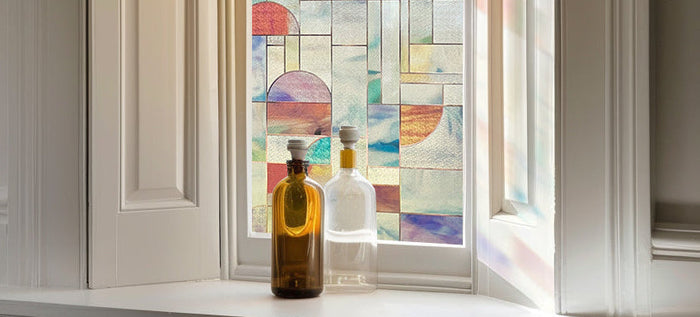
Printed patterns
Printed decorative window film carries a full-colour design printed onto the film — florals, geometrics, abstract colour blocks, line-art silhouettes. Printed film is the widest part of the category and the part where an original library matters most, because the motif is the only thing a shopper is choosing between. FancyFix prints from its own drawings.
Designs hub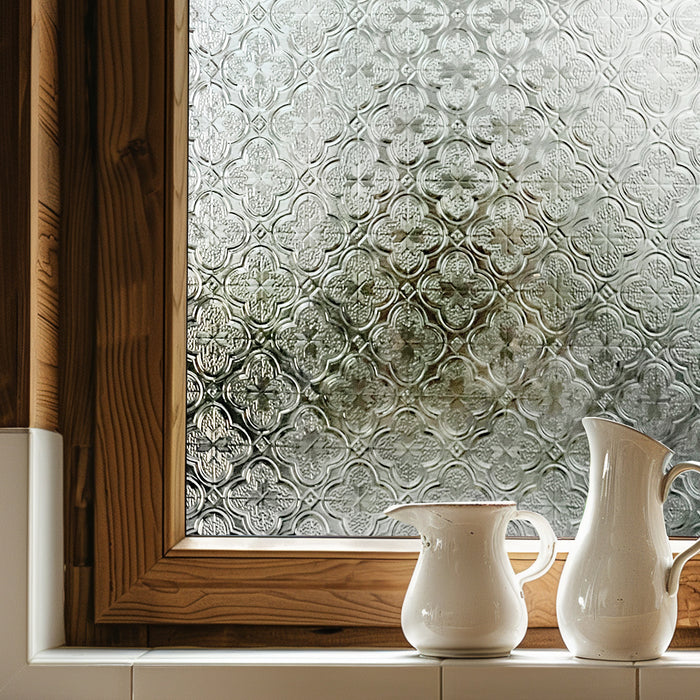
Etched & sandblasted looks
Etched-glass window film reproduces the look of acid-etched or sandblasted glass — a matt worked surface with a clear pattern cut through it — on a film that goes onto ordinary glazing. Etched-look film sells where a specifier wants the finish of worked glass without replacing the pane, which puts it on office partitions, front doors, and street-facing windows.
Designs hub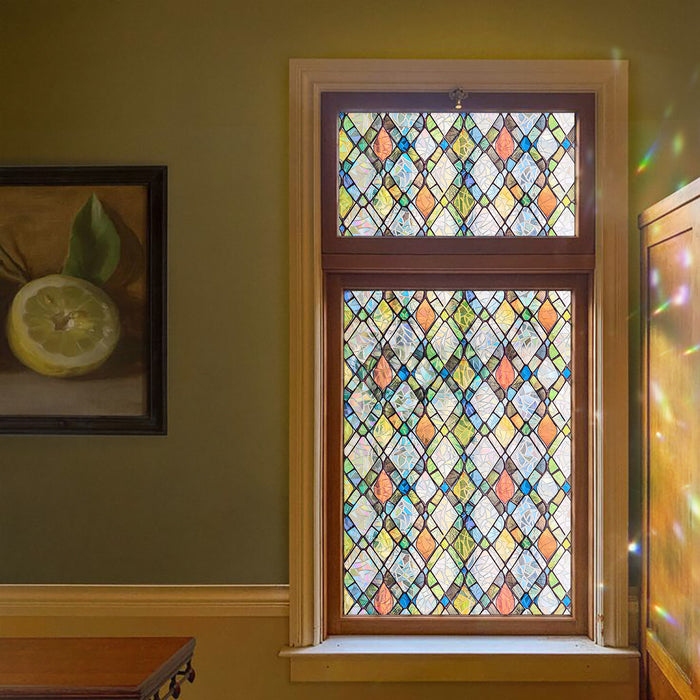
Holographic & iridescent
Holographic and iridescent window film carries a micro-structured layer that splits daylight, so the same panel shifts colour as the viewer moves past it. Rainbow and dichroic effects sell on the effect itself rather than on a motif, which makes them a display, event, and interior product as much as a whole-house one.
Designs hub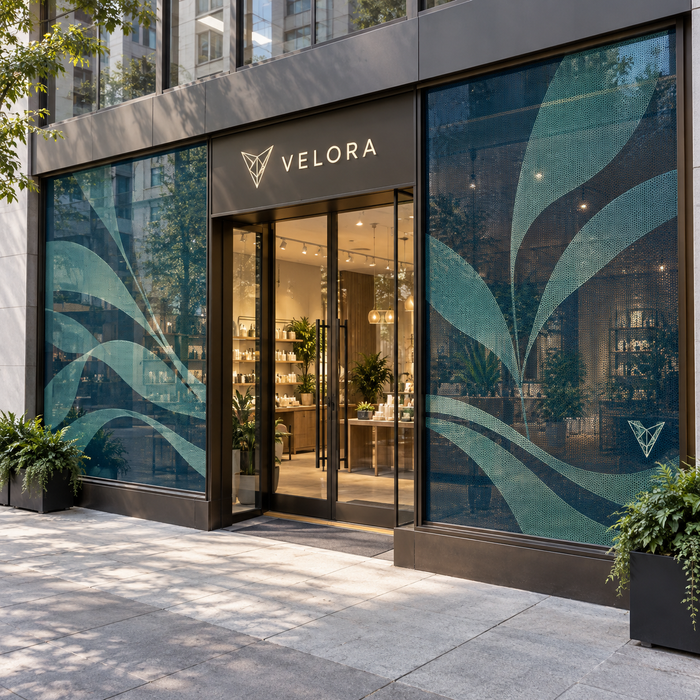
Perforated & one-way vision
Perforated window film is a printed sheet punched with regular holes, so a graphic reads as solid from the brighter side while someone on the darker side still sees out through it. Perforated film is the shopfront and vehicle-glass product in the decorative range, bought by sign makers and fit-out contractors rather than off a retail shelf.
Designs hub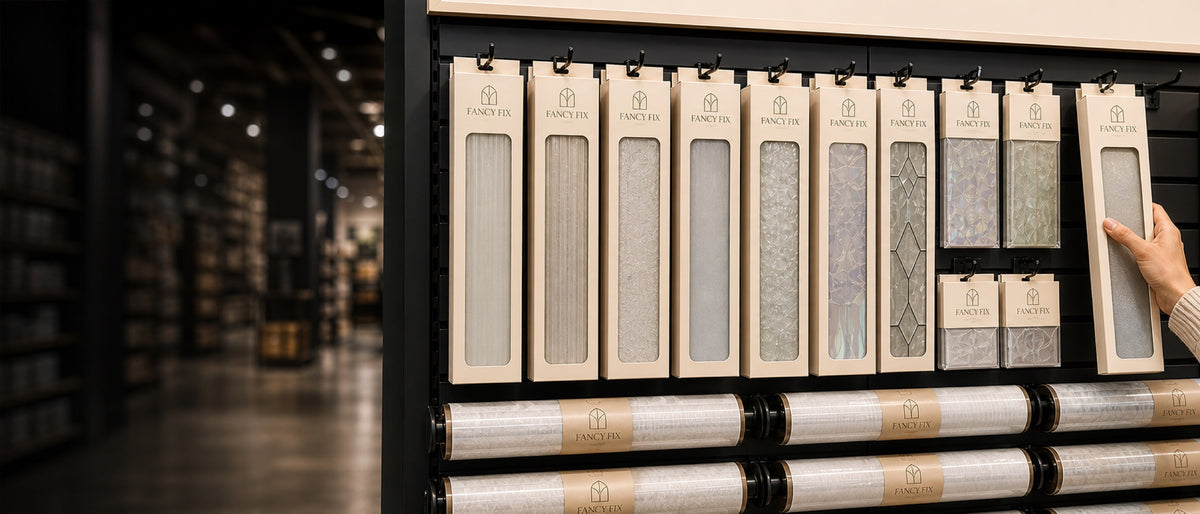
Where decorative film sells.
Decorative window film is an impulse product on a shelf, a thumbnail product online, and a specified product on a project. FancyFix builds the range around how you sell it.
Retail shelves (primary).
Merchandised for big-box and specialty retail — hardware and building-materials stores, home-decor stores, and dollar stores. Product FancyFix manufactures reaches retail chains like Walmart, Home Depot, Lowe's, Kmart, and Nitori — under our partners' brands, not ours. A window-cut carton that shows the actual motif does more of the selling here than any claim printed beside it.
Online marketplaces (primary).
Sized and packaged to win on Amazon, Wayfair, Temu, TikTok, and eBay, where the first image decides the click. A decorative motif has to hold up at thumbnail scale before it holds up on a window, so FancyFix sets the scale of a pattern against the listing grid as well as against the glass.
Studios, signage and fit-out (secondary).
Design studios, sign makers, and fit-out contractors buy decorative film by the roll for one scheme rather than in a retail pack — etched-glass looks on partitions and doors, perforated graphics on shopfronts. FancyFix supplies both formats from a single design, so a distributor can serve a retail shelf and a trade counter without carrying two ranges.
FancyFix gives you three ways to get a pattern.
A decorative range fails when the designs are the ones every other supplier is offering that season. The three routes below differ by who originates the drawing and who ends up owning it — and all three run on the same production line and the same base films.
From our library.
Take an existing FancyFix pattern and put it under your brand and packaging. Using the existing library is the fastest route onto a shelf, and that library is our studio's own work rather than bought-in files, so there is no third-party licence sitting behind the design you sell.
Developed to your brief.
Bring a direction — a palette, a trend, a room, a reference — and the FancyFix studio originates a pattern for it. A buyer gets a design nobody else is selling without running a design team, which is the usual reason a range is commissioned rather than taken off a standard offer.
Exclusive to you.
A pattern developed for you can be held exclusive: FancyFix commits in writing that a customer's own pattern is never used for our own retail and never sold to a third party. A written exclusivity commitment is what makes a brand willing to build a line around a single design.
Same three routes across printed, etched, holographic, and perforated films.
The numbers a decorative-film buyer asks for first.
Thickness, width, range, and local stock for FancyFix decorative window film — stated as figures, not adjectives. Sampling and production lead times are on the capabilities page.
0.18–0.25 mm
FancyFix stock decorative static cling window film runs 0.18 to 0.25 mm thick with the release liner on, across embossed, 3D-refraction and colour-printed builds. Each cling build is a PVC face film on a PET release liner.
120 cm
FancyFix produces decorative window film to a maximum width of 120 cm, with regular shipping widths of 45, 60 and 90 cm, plus 120 cm on 3D-refraction and printed film. Stock lengths are 150, 200 and 300 cm, with no maximum length.
600+ SKUs
FancyFix runs more than 600 SKUs across window film, wall coverings, floor and furniture film, and craft vinyl, and adds 10 to 15 new designs every month — all of them original, developed by the in-house design team.
4 US warehouses
FancyFix holds local stock in California, Pennsylvania, Illinois and Georgia, plus Germany, the United Kingdom and Australia, so a window-film reorder ships from local inventory instead of starting another ocean-freight cycle.
FancyFix decorative film, by specification.
PVC (softer, easy to print and emboss, conforms to curved glass) or PET (higher clarity, more stable). Specified by line.
Printed — full-colour motifs on clear or frosted film.
Etched & embossed — a worked matt surface that reads as acid-etched or sandblasted glass.
Holographic & iridescent — a micro-structured layer that splits daylight into shifting colour.
Perforated — a printed sheet punched for one-way vision.
Static cling (no glue, repositionable, smooth flat glass only), low-tack removable, and permanent adhesive. The tack level is specified per order rather than fixed by the design — the same pattern runs on all three.
Decorative film is specified for how it looks, not for how much it hides. A dense printed or etched surface does obscure the view to some degree, but where obscuration is the requirement the line is graded as a privacy film and the tier is printed on the pack.
Retail pre-cut packs for a shelf or a listing, and rolls in custom widths for trade, signage, and project supply — both available with private-label packaging.
Decorative window film — questions buyers ask before an RFQ.
Decorative window film is film applied to glass for the pattern or finish it carries — printed motifs, etched-glass surfaces, holographic layers, perforated sheets. Privacy film is specified by how much it obscures, and solar film by how much heat and glare it rejects; decorative film is specified by how it looks. The three overlap in practice, because a dense printed film also blurs the view, but the buying decision is different. FancyFix grades each line by whichever property the customer is actually selling on.
Partly, and it should not be sold as a privacy product unless the line has been graded to an obscuration tier. A dense printed or etched pattern blurs shapes behind the glass, while an open motif on clear film leaves the view largely intact. FancyFix prints that tier on the pack, so a shopper can tell the difference before buying; a line sold on its motif does not carry the claim at all.
FancyFix runs its own retail listings in the categories it manufactures, so a pattern is put in front of real shoppers before it is offered as a wholesale range. The designs people actually choose are the ones drawn up into a partner's line. Running a factory and a live storefront at the same time is what makes that method possible, and no trading company can reproduce it.
Perforated window film is a printed sheet punched with regular holes. From the brighter side the printed surface dominates and the graphic reads as solid; from the darker side the eye looks through the holes and the view is largely kept. Shopfronts and vehicle glass are the usual application, where a full graphic outside and a working window inside are both required.
Holographic and iridescent window film carries a micro-structured layer that splits daylight, so the panel shifts colour as the viewer moves past it. Holographic film sells on the effect rather than on a motif, which puts it in displays, events, retail interiors, and children's rooms more often than across a whole house. FancyFix produces it on the same base films as its printed range, so it can sit inside one retail line.
Yes. An etched-glass look is printed and surface-finished so the film reads as acid-etched or sandblasted glass, which is the usual specification for doors, partitions, and street-facing offices. Leaded and cathedral-glass looks are produced too, and FancyFix keeps those in the stained glass window film range rather than here, because buyers shop them as a separate category.
FancyFix stock decorative static cling window film is 0.18–0.25 mm thick with the release liner on, across embossed, 3D-refraction and colour-printed builds. Each FancyFix decorative cling build is a PVC face film on a PET release liner; adhesive decorative window film normally uses a PET face film. Maximum width is 120 cm, with regular shipping widths of 45, 60 and 90 cm, plus 120 cm on 3D-refraction and printed film. Stock lengths are 150, 200 and 300 cm, with no maximum length. Most FancyFix stock sits inside these figures; custom thickness and sizes are produced to order.
Continue by effect, capability, or buyer path.
Tell us the effect, the base film, your target quantity, and your channel — FancyFix responds within 24 hours with a tailored quote and a sample path.
Request a Quote