Privacy window films are a beautiful and affordable way to control how much of your indoor space is visible from the outside. They are easy to install and you can use them in your home, office, or business premises. For commercial buyers, contractors, and large-scale procurement managers, selecting the right film for windows for privacy can also support long-term operational efficiency and brand image consistency across multiple locations. Modern designs also provide essential benefits such as protection against UV rays and higher energy efficiency. Many procurement specialists evaluating the best window films for privacy consider not only aesthetics but also durability, compliance standards, and bulk supply stability.
So, are privacy window films a magic product? Certainly not. Each of their functional benefits is based on scientific innovation. Understanding how does privacy film work helps purchasing managers and project developers make informed decisions when sourcing materials for large commercial projects.
Read on as we dig into the science of it all and demystify how privacy window films work, including insights into how does privacy glass work compared to film-based solutions.
Privacy Window Film Features
Privacy window films are often using vinyl or a specially engineered type of polyester. For wholesalers, distributors, and commercial property developers seeking film for windows for privacy, material composition is a critical factor in long-term performance and scalability. They are designed to offer:
- Privacy– when window film is affixed to a window, it should limit how much of your indoor home or office space is visible from the outside.
- Light transmission– privacy window films control the amount and intensity of light rays that flow through your windows. You can choose how much or how little light you want by choosing a window film with the appropriate level of light transmission.
- UV protection – most privacy window films control the amount of UV rays that come through your windows to protect your wellness and the assets in your space from UV damage.
- Temperature control (optional) – energy-efficient privacy window films mitigate the amount of heat that flows in and out of your space through the windows. This can help to keep your home warmer during winter and cooler during hot seasons.
Now that we have some insight into the features of privacy window films, let us explore how each works, shall we?
Privacy Control
The flow of light enables us to see everything around us. Subsequently, anything that obstructs or limits the flow of light equally limits how much you can see in a space.
Window films provide privacy based on this principle. They control how light flows through your windows and, in turn, limit how much of your interior space is visible to outsiders. This fundamental explanation directly answers the question: how does privacy film work in practical architectural applications?
Notably, there are different types of privacy of window films. So, depending on the design, window films control the flow of light and offer privacy in one of the following ways. When evaluating film for windows for privacy at scale, buyers should consider which scientific principle best aligns with their project requirements.
Light Reflection

Source: fancyfix
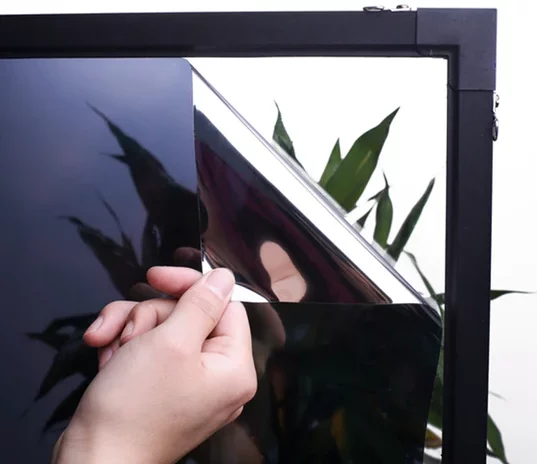
Some privacy window films are manufactured with reflective properties. Manufacturers achieve this by adding a metallic coating to the films during production.
The reflective design of the privacy window films equips them to bounce light rays away from your windows. This makes it hard for anyone to see inside your space because the reflective film casts the light back outside and disrupts their ability to see through the glass. Reflective options are frequently listed among the best window films for privacy for office buildings and commercial storefronts due to their daytime one-way visibility advantage.
Light Distortion
Source: fancyfix
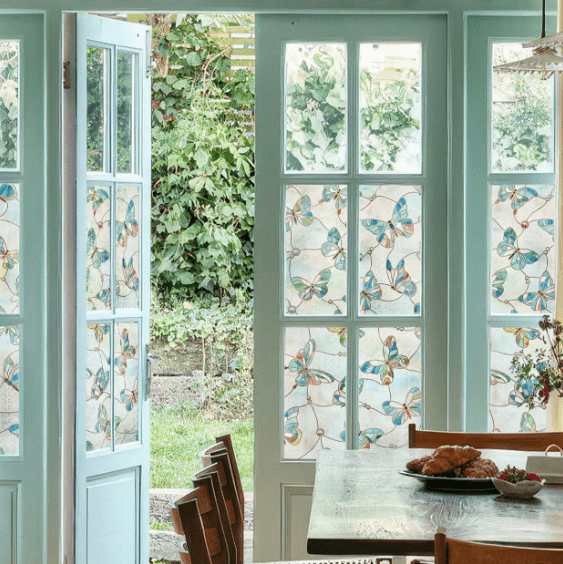
Light flows in rays to illuminate different objects and spaces. Privacy window films with a frosted or roughened finish do not allow light rays to flow through them directly like they would flow through a transparent film. Instead, they have tiny particles ingrained in them that scatter light rays in different directions. The scattering of light causes a blurring effect.
Naturally, the blurring limits anyone on either side of the window from seeing through it thereby creating a privacy barrier. This approach to privacy is common in decorative window films.
Light Absorption

Source: fancyfix
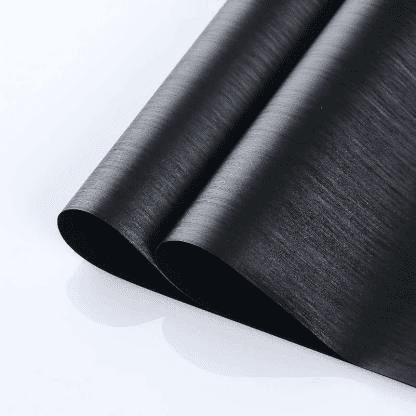
Different colors allow different amounts of light to flow through them. Darker colors like black, for example, absorb more light than they allow to pass through. This absorption mechanism is central to understanding how does privacy glass work when tinted or coated materials are used.
Privacy window films coated in such colors limit the light that flows into and out of your space. As a result, it makes it hard for anyone outside or inside to see through the windows. This approach is also known as tinting. Tinted products are commonly included in lists of the best window films for privacy for commercial fleets, shopping centers, and large office buildings.
Liquid crystal window films also use this approach to create a privacy barrier. They are made with a special layer of liquid crystals and electric conductors. The electrical conductors are connected to a power source with a switch. These components work to create a privacy barrier as follows. For facility developers and smart-building integrators asking how does privacy film work in switchable systems, the process is explained below:
- When the electric current is off, the liquid crystals align in the same direction and allow light to flow through them. You can, therefore, see through the window.
- When you turn the switch on, electric current flows through the conductors and through to the liquid crystals.
- The liquid crystals no longer align in the same direction as electric current flows through them.
- The distorted order of the liquid crystals scatters any light rays that attempt to flow through the window film.
- The scattered flow of light creates a blurring effect.
- The blur works as a privacy barrier as it makes it difficult to see through the window film.
UV Ray Protection
UV ray protection is an extra benefit that you may find in most privacy window films. However, different types of window films offer different levels of protection from ultraviolet rays. Manufacturers can achieve UV protection in window films through three different options:
- Metallic components– thin layers of metallic materials like silver or titanium are efficient at bouncing off UV rays. Adding them to window films ensures the film can reflect a large portion of UV rays away from windows.
- Multi-layered window films– manufacturers layer and compress multiple materials to create a privacy window film. One or more of the materials have to be able to either absorb or reflect UV rays from the windows.
- UV ray absorption– the manufacturers coat or dye the materials used to make the window film with chemicals that enable them to absorb UV rays and convert them into heat. The heat dissipates into the atmosphere.
Temperature Control
Light rays from the sun also radiate heat into the atmosphere. Therefore, when privacy glass films reflect or absorb sun rays, they also impact the transmission of heat through the windows. For commercial buyers evaluating film for windows for privacy, thermal insulation performance can significantly influence ROI calculations.
Reflection reduces the amount of solar heat that comes in through the window which keeps your space fairly cool. Meanwhile, when a window film absorbs sun rays or the ambient heat in your space, it means that heat dissipates through your windows at a slower rate. This helps to keep your space warmer during cold seasons. These thermal properties further explain how does privacy film work as part of broader energy-efficiency strategies in commercial buildings.
Conclusion
At first impression, the benefits of privacy window films can sound too good to be true. Understanding how they work, however, reveals that every feature is based on scientific innovation. It proves that quality window films can indeed provide reliable privacy and improve the comfort, energy efficiency, and ambiance of your space.