Decorative Privacy Window Film: Types, Light Control & Cost Analysis for Bulk Buyers
Meta Description
Decorative privacy window film guide covering types, light control performance, and cost analysis to help bulk buyers choose the right solution for commercial and large-scale projects.
Introduction
Searching for an intelligent way to improve privacy that doesn’t cut you off from sunlight? Nowadays, privacy window film offers a highly convenient, versatile, and affordable option for offices, retail spaces, healthcare facilities, and large commercial projects. There is a wide variety of solutions with a film range from entirely opaque window films to decorative privacy window film that allows light in, which now perfectly marries discretion, style, and energy efficiency.
This guide will help you comprehend the different kinds of light performance and highlight how experienced suppliers like Fancyfix manage manufacturing capacity, customization flexibility, and global delivery logistics.
What Is Decorative Privacy Window Film
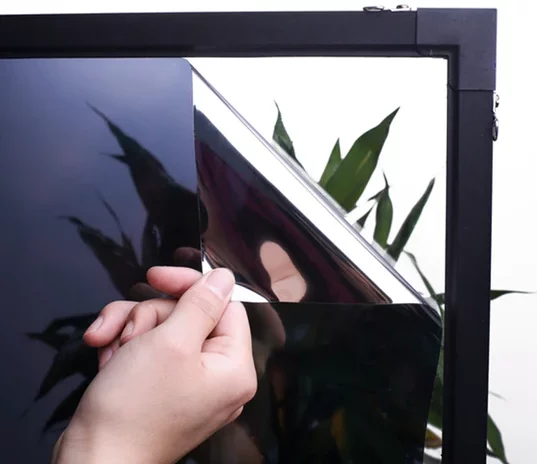
Decorative privacy window film can be considered a self-adhesive or static-cling solution that is placed on glass to provide increased privacy without losing the design aspect or the light. In contrast to etched or frosted glass, it allows changes in opacity, pattern setting, and replacement, which are some of the features that make it perfect for both temporary and permanent commercial applications.
Depending on the specification, it can serve as opaque film windows that visually block to the maximum or as a privacy window film component that allows light to pass, thus balancing the need for privacy with the benefit of natural light.
Common applications
-
Office glass partitions and meeting rooms: Allow creating private workspaces without losing an open, modern office layout.
-
Retail storefronts and branded display windows: Bring out the best in brand visuals while managing the exterior visibility.
-
Supermarkets and large commercial chains: Ensure uniform privacy from one store to another without altering the structures.
-
Hospital rooms and clinic partitions: Give the patient the necessary privacy, and at the same time, the light can go through to keep the environment comfortable.
-
Residential bathrooms and balconies: Keep outsiders’ eyes away while the rooms are not completely darkened.
-
Hotel lobbies and hospitality interiors: Decorates the environment while subtly defining the semi-private zones.
Main types of decorative privacy film
Selecting the best privacy window film is primarily a function of how many of the views you want to block and preserve, or keep running light. Here are the three most popular types that are employed in industrial as well as bulk projects:
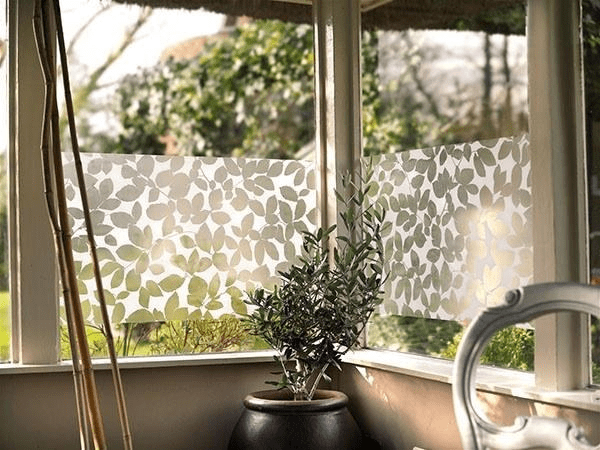
Frosted / translucent film
This is the top choice for office and retail space decorations. It serves as a privacy window film while still letting light in, scattering the sunlight, and making the shapes and movement visually indistinct.
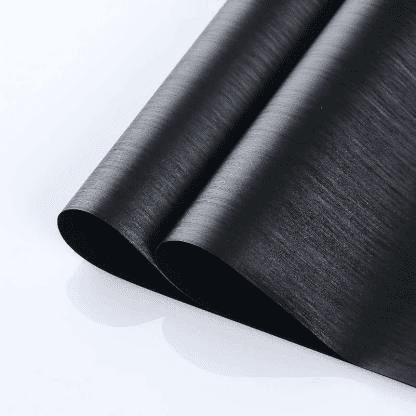
Opaque Privacy Film
For the utmost privacy, this product metaphorically leaves no windows to the outside world. It is a great one if the room is a storage area or a work area with sensitive information.
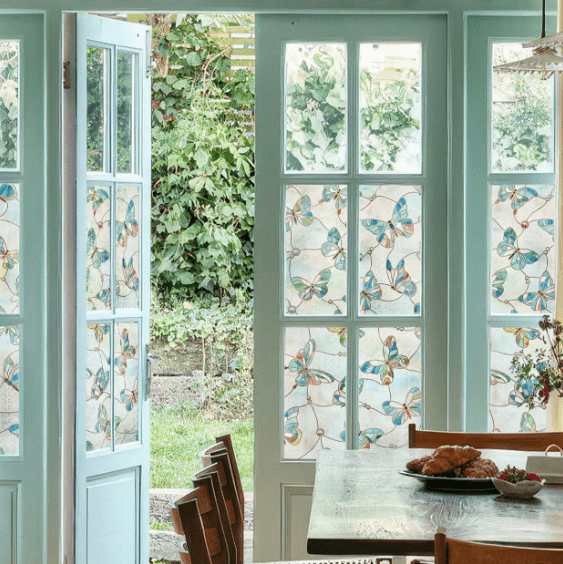
Pattern / stained-glass style film
These decorative films are an exquisite mix of privacy and style. Besides geometric, floral, or custom patterns, they also provide moderate light filtering window film features that can be helpful in commercial spaces while improving the branding and interior look.
Privacy vs Light Control: How Different Films Perform
Choosing a privacy window film isn’t just a matter of one question, i.e., “How private is it?” It also involves “How much light will it let in?” Each film manages the trade-offs between visibility and brightness differently.
Frosted/translucent films
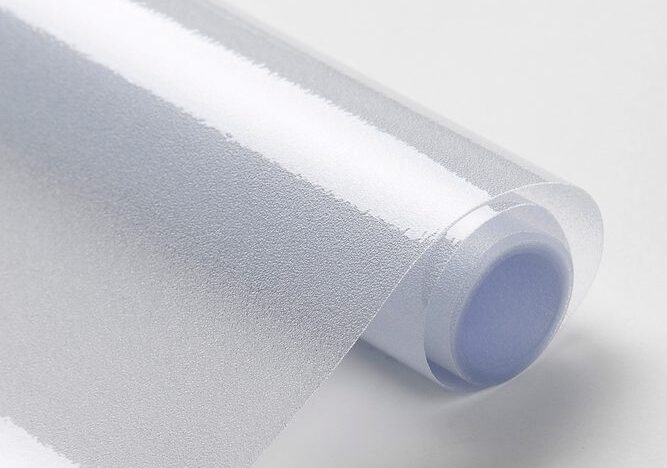
They provide privacy window films that allow light to enter, diffusing sunlight, and at the same time hiding details. They lessen glare without darkening the rooms, so they are very suitable for offices, clinics, and shops that depend on natural light.
Light filtering window film
This one makes the daylight less glaring and more comfortable while it also helps to keep some visibility. Its major use is in commercial spaces where managing the level of brightness is more preferred than total concealment.
Opaque or light blocking window film
If complete coverage is needed, light-blocking window film does the trick by greatly lessening or totally blocking light transmission. Like opaque film windows, it is best for places that need high security, like the rooms, back offices, or the storerooms.
Dimmable Window Film
There is window film that may electronically adjust its transparency, and that is the dimmable one used in advanced projects. Privacy and light control in demand are two main features of this one, so it is perfect for modern conference rooms and the most luxurious commercial installations.
Decorative Privacy Film vs Factory Etched Glass
Choosing between factory-etched glass and decorative privacy films for commercial projects can affect the budget, installation process, and the ability to change in the future.
Permanent vs Flexible Privacy
The design of factory-etched glass remains permanent after installation. One can only get a new panel if they want to change the pattern or opacity. However, decorative privacy films provide different levels of privacy and can be removed, upgraded, or changed as business needs fluctuate.
Installation Effort and Disruption
Etched glass is solid, and installation needs to be done by a professional. Window film for privacy is thin and can be applied to existing glass surfaces, so downtime is minimized.
Cost and Scalability
Etched glass has a high initial price, especially for large orders with many locations. Decorative films are a cheaper option, particularly when installation, delivery, and future changes are also considered.
Customization and Design Options
Although etched glass has fewer design options, decorative privacy films can have patterns, gradients, logos, and even dimmable features.
Experienced suppliers like Fancyfix leverage their manufacturing-backed operations to deliver both stock and custom films worldwide (Stock products can be shipped in 7-15 business days, while customized products’ turnaround times are 10-20 business days), ensuring consistent quality, reliable lead times, and support for large-scale commercial projects.
Cost Comparison: Decorative Privacy Film vs Stained-Glass Window Film for Bulk Projects
With multiple sites involved, the price of privacy window film becomes a crucial factor in the budget:
-
Stained-glass Window Film: Very high initial cost because of the raw material, making, and installation; changes or replacements are costly.
-
Decorative privacy film: Smaller initial spending, easier to install, and less hassle. With a large-scale project, film cuts down on labor, shipping, and replacement costs while still offering design flexibility.
Why is a Decorative Privacy Film a More Versatile Option?
Commercial buyers always look for flexibility and scalability. Decorative privacy film provides several benefits that neither etched nor stained glass can.
-
A film can be installed on doors and windows that are already there without any disruptions from construction.
-
Capable of accommodating various opacity levels and patterns, ranging from solid (opaque) to decorative or even dimmable films.
-
Replacement is not only easier but also quicker and restyling new changes in the tenant, rebranding, or the different phases of an expansion.
Having been in the international B2B supply market for over two decades, Fancyfix, with its wide range of customizable film options and extensive supply chain capabilities such as R&D, manufacturing, packaging, and international delivery facilities for large-scale production and delivery, assists buyers in realizing these advantages.
Comparison Table: Film Type vs Privacy Level vs Light Transmission vs Cost
| Film Type | Privacy Level | Light Transmission | Approx. Cost for Bulk Deployment | Ideal Use Case |
| Frosted / Translucent | Medium | High (diffused light) | Moderate | Offices, meeting rooms, retail partitions |
| Opaque Privacy Film | High | Low (blocks most light) | Low-Moderate | Storage areas, sensitive workspaces, back offices |
| Patterned / Stained-Glass Style | Medium | Medium | Moderate-High | Branding, decorative interiors, lobbies |
| Dimmable Window Film | Adjustable | Adjustable | High | Premium offices, conference rooms, flexible spaces |
Conclusion
For commercial buyers and bulk buyers, privacy window films that are decorative provide more flexibility, are more cost-efficient, and can be installed with less trouble compared to permanent means, such as the use of etched or stained glass. Fancyfix, a supplier with more than 20 years in the industry and backed by manufacturing capabilities, is supporting bulk buyers with the option of customized designs, dependable production, and worldwide delivery, thus making the large-scale deployments less complicated and more certain.